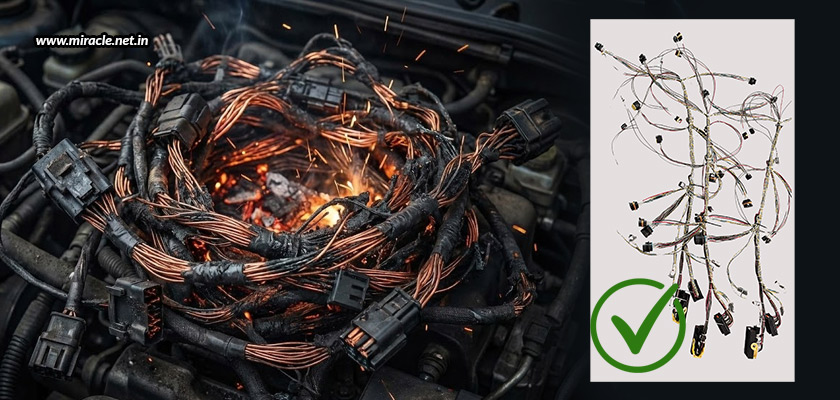
Automotive electrical systems have significantly increased in complexity over the last few years, with electronic control units, sensors, and extensive wiring connected together to manage everything from engine control and navigation to connectivity, infotainment, and safety features. So, what is it that makes such a complex system seem so simple and easy to manage? It is the wire harness, which is crucial for the performance, reliability, and safety of the car’s multiple systems. A single fault in this connection can mean fatal system failure! It is thus important for manufacturers, automotive engineers, and component suppliers to check for the reasons behind wire harness failures, and address them at the earliest to mitigate any potential issues in the future.
The essential role of automotive wire harnesses
Wire harnesses within a car connect the electrical cables of different systems together, and route them into a single cohesive assembly to supply electrical power to the different components within a system, as well as relay data signals between different networks. As cars today are increasingly incorporating different electrical systems, advanced technologies, and driver-assistance systems, the wire harness has evolved from a basic wiring bundle into a complex networked architecture. This architecture, although has made it easy for the different systems to work cohesively, has also introduced vulnerabilities and the potential for failures. And, when such failures occur, they can hinder critical vehicle operations!
Common causes of wire harness failures in cars
Wire harnesses can fail from a mix of mechanical, electrical, thermal, and environmental stresses, with the most common causes explained below.
- Routing and design errors
Design errors like insufficient lengths, inadequate margines, overly tight bends, incorrect clip positioning, and too little strain relief can impact the entire functioning of a vehicle. In fact, one wrong design across thousands of cars means all the thousands of cars are impacted! Moreover, poor routing such as placing wires too close to heat sources, sharp edges, or areas with high vibration can also significantly increase the risk of wire failure. Design validation is thus a very crucial phase in wire harness development.
- Mechanical damage and abrasion
Mechanical wear is one of the most common reasons for a wire harness failure. Wires, when routed through tight spaces, may rub against metal frames, sharp edges, and moving components, which can strip the insulation and expose the conductors underneath, leading to short circuits. Such kind of mechanical wear is seen commonly in doors, tailgates, steering columns, and engines. The most common problems encountered with such mechanical abrasion include flickering lights, malfunctional switches, or even total system shutdowns.
- Connector and terminal failures
Connectors serve as the actual contact points within wire harnesses that are responsible for proper circuit functioning. But, when there are poorly crimped terminals, loose connectors locks, deformed or bent pins, incorrect terminal insertion, or corrosion at the pin–socket interface, it can affect the functioning of the connector, and thus the circuit. This can lead to signal loss or voltage drop, which in turn impacts the control units, brakes, and other such essential systems.
- Electrical overload and short circuits
Electrical stresses like sudden voltage spikes, short circuits, or overcurrent can damage the wires, melt the insulation, and cause irreversible damage to the connectors. Such electrical faults may occur as a result of exposed conductors due to wear, retrofitted accessories, faulty aftermarket wiring, malfunctioning relays, system malfunctions, or even due to rodent damage to the wires.
- Thermal stress
Extreme temperatures can affect both the conductors and insulation of a wire harness. Conductors can lose their mechanical integrity due to thermal expansion, while insulation can crack, melt, or become rigid when exposed to high temperatures. The most common elements that can be impacted due to thermal stress include those near hot engine components, exhaust manifolds, and turbochargers.
- Corrosion and moisture
Even if everything within the car and its system is working fine, but if there is an opportunity for moisture to get in, it can prove to be one of the most damaging elements. When moisture, humidity, or water penetrates the connectors or harness channels, it can lead to corrosion and diminish conductivity. This becomes possible due to damaged grommets, obstructed drainage paths, pressure washing, leaks in the trunk or cabin, or exposure to road salt.
Preventative strategies
The automotive industry has made significant investments over the years to overcome common challenges and avert wire harness failures by using high-quality materials, the best engineering techniques, and putting rigorous testing procedures in place. All of this can help guarantee long-term reliability of the wiring systems.
- Using high-quality materials
Manufacturers incorporate high-quality materials like high-temperature rated insulations including silicone, Teflon, and XLPE. They also work on using flame-retardant sheathing, sealed connectors, and abrasion-resistant tapes. Lightweight allows and improved conductor coatings can also enhance both mechanical strength and thermal stability. Furthermore, waterproof connectors with IP67/IP68 ratings effectively prevent moisture from infiltrating sensitive circuits. In addition, braided sleeving, corrugated tubing, and heat shields offer extra layers of protection.
- Strong routing and robust design
Engineers use digital modelling and CAD systems to simulate harness routing before production, to detect any potential hazards such as vibration zones, pinch points, and areas exposed to heat. Clips, fasteners, and grommets are strategically positioned to secure the harnesses well. Strain relief sections prevent wire fatigue in frequently moved areas. Moreover, shielded paths for high-voltage cables help avoid interference. Manufacturers use the best of automated crimping machines, laser stripping machines, and ultrasonic welding to guarantee consistent procedures, thus minimizing the likelihood of fault components and loose connections.
- Testing, validation, and quality assurance
Manufacturers make sure to test the wire harnesses for a number of factors before having them delivered for inclusion in the vehicle. These include continuity and resistance examinations, waterproof and sealing verifications, salt spray and humidity exposure tests, thermal cycling and heat aging evaluations, and EMI/EMC compliance assessments. Such tests check for electrical stability, environmental resistance, long-term durability, and reliable signal integrity, ensuring that harnesses can endure years of operation without failure.
As vehicles continue to rely heavily on electronics, wire harnesses will remain essential. They are safety-critical components that must function accurately for years. Ensuring their reliability is not just a technical requirement; it is vital for overall vehicle safety and customer trust. With ongoing advancements in materials, simulation tools, and electrical system design, manufacturers are now better equipped to build vehicles with durable and long-lasting wiring systems. Companies like Miracle Electronics, one of the leading car wiring harness manufacturing companies in India, play a key role in supporting this shift toward safer and more dependable automotive electrical architectures.