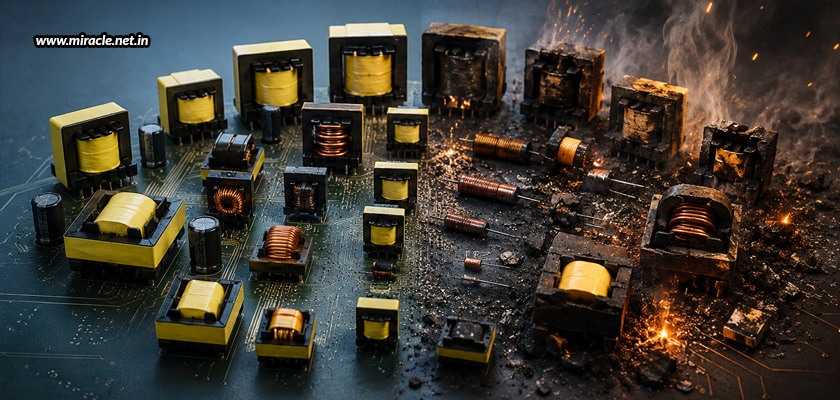
SMPS are prevalent in contemporary electronic systems due to their efficiency, compactness, and capability to provide stable power for a variety of applications. They are essential in industries ranging from consumer electronics and communication systems, to automation and medical devices, ensuring reliable power delivery. Nonetheless, like all electronic components, SMPS systems are susceptible to failures caused by electrical stress, thermal problems, inadequate design practices, or unsuitable operating conditions. A failure in an SMPS can result in equipment downtime, diminished system efficiency, and expensive repairs. It is crucial for engineers and designers to comprehend the typical causes of these failures to enhance reliability and prolong operational lifespan. Let’s delve into the primary factors contributing to SMPS failures and effective strategies for prevention to ensure improved performance and durability.
Voltage surges and electrical overstress
SMPS units frequently encounter unpredictable voltage variations, including power surges, spikes, and transient events. These electrical disturbances can harm sensitive components like MOSFETs, rectifiers, capacitors, and control ICs. Voltage spikes pose a significant risk in high-frequency switching circuits, as semiconductor devices function with very brief switching intervals. A sudden voltage increase that exceeds the component’s rating can lead to breakdown and immediate failure. Common sources of voltage-related failures include power grid instability, lightning strikes, and inadequate protection circuits.
Prevention strategies
To protect components from electrical overstress, protection circuits should be incorporated into SMPS designs. Surge protection devices such as Metal Oxide Varistors, transient voltage suppressors, and input protection circuits are effective in absorbing sudden voltage spikes. Choosing components with adequate voltage margins instead of operating them near their maximum ratings enhances reliability. Conducting proper testing under various voltage conditions ensures that the SMPS can endure real-world electrical environments.
Excessive current loading and overload conditions
Each SMPS is engineered to provide a specific output current within established operating parameters. When the load connected to the SMPS requires more current than it can supply, it places undue stress on switching devices, transformers, and other power components. Overloading can lead to increased heat production, voltage drops, and potential damage to components. Sudden current surges caused by short circuits or malfunctioning downstream equipment can severely damage the power supply if proper protection measures are not in place.
Prevention strategies
Contemporary SMPS designs include protective features like overcurrent protection, short-circuit protection, foldback current limiting, and automatic restart mechanisms. These features are essential in preventing excessive current flow and safeguarding both the SMPS and the connected devices. Conducting a thorough load analysis during the design phase is also crucial. Engineers must verify that the chosen SMPS has adequate power capacity and should avoid operating it continuously at or near maximum load conditions.
Overheating and poor thermal management
During operation, components like switching transistors, transformers, inductors, and power diodes incur power losses that transform into heat. If this heat is not adequately dissipated, the temperatures of these components can surpass their safe operating thresholds. This can quicken the aging of components, diminish efficiency, and lead to irreversible damage. Factors like poor ventilation, insufficient heatsinking, incorrect component placement, and operation in high-temperature settings further lead to overheating.
Prevention strategies
Effective thermal management should begin right at the designing phase of the SMPS transformer. Choosing components with suitable temperature ratings, optimizing PCB layouts for enhanced airflow, and utilizing appropriate heatsinks can greatly alleviate thermal stress. Thermal simulation tools can assist designers in forecasting heat distribution and pinpointing potential hotspots prior to manufacturing. Furthermore, incorporating temperature monitoring and protective measures like thermal shutdown can avert damage during abnormal conditions.
Transformer and magnetic component failures
The transformer is a crucial element tasked with energy transfer and voltage conversion. A poorly designed transformer can result in overheating, insulation failure, reduced efficiency, and erratic performance. Frequent transformer-related problems include improper core selection, inadequate winding design, high leakage inductance, and insufficient insulation between the primary and secondary windings. Operating the transformer beyond its specified frequency or power limits can lead to magnetic saturation, which may cause excessive current draw and failure of switching components.
Prevention strategies
Effective transformer design is vital for the dependable operation of an SMPS. Choosing appropriate core materials, optimizing winding layouts, and ensuring adequate insulation distances contribute to enhanced performance. The transformer must fulfill application-specific requirements like frequency range, power capacity, thermal efficiency, and compliance with safety regulations to ensure reliable energy conversion, improved durability, and consistent performance under varying operational conditions.
Capacitor failure and aging issues
Capacitors play a crucial role in filtering, energy storage, and ensuring stable output voltage. Over time, capacitors undergo degradation due to factors like temperature, ripple current, and prolonged operation. Electrolytic capacitors are especially at risk as their internal electrolyte gradually breaks down. An increase in Equivalent Series Resistance leads to diminished capacitor performance, which can cause heightened ripple voltage, overheating, and unstable output. Symptoms of a failing capacitor may include output fluctuations, increased noise levels, reduced efficiency, or even a complete shutdown of the SMPS.
Prevention strategies
To ensure long-term reliability, it is vital to use high-quality capacitors that meet the appropriate voltage, temperature, and ripple current specifications. Designers should opt for capacitors that are specifically engineered for switching power applications. Lowering operating temperatures, enhancing airflow, and steering clear of excessive ripple currents can greatly prolong the lifespan of capacitors. In critical applications, utilizing solid-state or polymer capacitors can offer greater durability compared to traditional electrolytic types.
Inadequate protection circuits
Protection mechanisms play a crucial role in safeguarding against damage during abnormal operating conditions. In the absence of adequate protection, even minor electrical disturbances can result in total failure of the SMPS. Typical protection features include overvoltage protection, overcurrent protection, short-circuit protection, thermal protection, and surge protection. The absence of these features heightens the risk of damage during unforeseen events and may significantly reduce the overall reliability, efficiency, and operational lifespan of the power supply system.
Prevention strategies
Protection circuits should be integrated during the initial design stage instead of being added later as an afterthought. Choosing dependable controllers with integrated protection functions and incorporating external safety components can enhance the overall durability of the system. Conducting regular tests under fault conditions is also essential to ensure that protection systems respond effectively and provide reliable protection against unexpected electrical stresses throughout the SMPS operating cycle.
Improper component selection
Utilizing subpar or incorrectly specified components can significantly shorten the lifespan of the system. For instance, choosing a MOSFET that lacks adequate voltage tolerance or a capacitor that does not meet the necessary ripple current rating can lead to early failure. Selecting components based solely on cost, without taking into account the operating conditions, frequently results in reliability challenges and can compromise the overall efficiency, stability, and long-term performance of the SMPS system in demanding applications.
Prevention strategies
Engineers must assess components according to their electrical specifications, thermal characteristics, reliability standards, and environmental factors. Components should possess adequate safety margins to accommodate fluctuations in load, temperature, and input voltage. For reliable transformer solutions, partnering with Miracle Electronics, an experienced SMPS transformer manufacturer in India, ensures application-specific designs, while proper testing and maintenance practices help identify potential issues and maintain long-term system performance.
SMPS failures can arise from multiple factors such as overheating, electrical overstress, capacitor wear, subpar PCB design, transformer problems, and insufficient protection. Nevertheless, many of these failures can be avoided through meticulous design, appropriate component selection, efficient thermal management, and comprehensive testing. As contemporary applications require enhanced efficiency, compact designs, and greater reliability, the creation of resilient SMPS systems has gained paramount importance. By understanding the most common failure mechanisms and applying preventive measures, engineers can create power supplies that provide consistent performance and prolonged operational lifespan across a variety of applications. Continuous innovation in power electronics, advanced simulation techniques, and improved manufacturing practices further contribute to developing SMPS solutions capable of meeting evolving industry demands with superior efficiency and dependable operation.