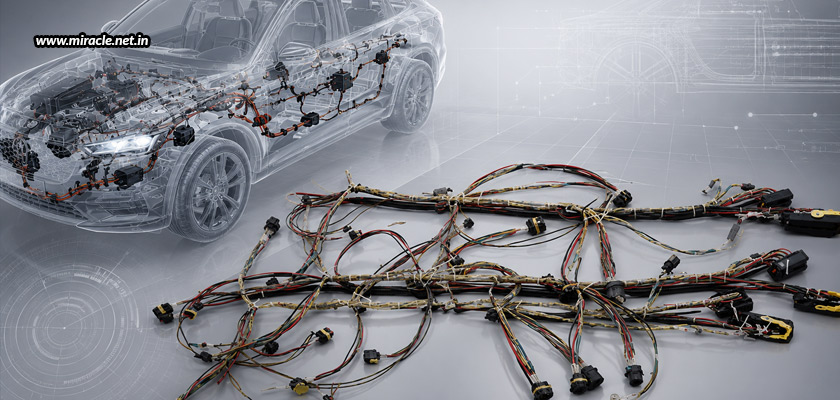
Modern vehicles today have evolved into highly complex systems, combining both electrical and electronic components. The entire system comprises of a network of interconnected modules controlling safety, performance, and infotainment. And, at the core of this entire network lies the automotive wire harness – a structured system responsible for transmitting power and data reliably across the vehicle. As vehicles continue to incorporate advanced driver assistance systems, electrification, connectivity, and intelligent features, standard wire harnesses are no longer sufficient. Custom automotive wire harness solutions have become essential for meeting evolving design and performance requirements. This blog explores why custom automotive wire harness solutions are essential in modern vehicles, highlighting design considerations, integration challenges, performance requirements, and how tailored harness systems support innovation, safety, and evolving mobility technologies.
Understanding the role of a wire harness in modern vehicles
A wire harness is a carefully engineered assembly of wires, connectors, and terminals, designed to distribute electrical power and signals throughout the vehicle. In today’s vehicles, harness systems support communication networks, infotainment systems, sensors, and safety-critical components, which makes them increasingly complex. Modern vehicles may contain thousands of circuits operating under varying voltage levels and communication protocols. And, without precise design and integration, wiring systems can fail to work well, while adding unnecessary weight to the vehicle, and creating long-term reliability challenges. This makes custom engineering important to ensure that the harness is designed around the vehicle’s architecture, rather than forcing the vehicle design to adapt to a generic wiring solution. It also enables better scalability for future upgrades, improved serviceability, and more efficient integration of emerging automotive technologies.
Why standard harnesses are no longer enough
In earlier vehicles, standard harness configurations were often enough, but today, modern vehicles demand a much higher level of precision and adaptability. The complex networks within a vehicle require wiring systems that align exactly with packaging constraints and performance requirements. A standard harness often struggles to accommodate unique routing paths, tight installation spaces, varying load demands, and integration with advanced electronic modules without requiring compromises. Custom solutions, on the other hand, address these limitations by aligning the electrical layout with the vehicle’s structural and electronic design from the outset. This proactive approach reduces complexity later in the development cycle and improves overall system performance. It also enhances installation accuracy, supports easier diagnostics, minimizes wiring redundancy, and ensures greater flexibility for future vehicle upgrades and design modifications.
Strategic performance advantages of custom automotive wire harnesses
Custom automotive wire harnesses are designed to improve vehicle performance, manufacturing efficiency, and long-term reliability. By aligning with specific vehicle requirements, they simplify integration, optimize space utilization, and support increasingly sophisticated electrical systems.
- Improving production efficiency through tailored design
Custom harness solutions are developed using digital design tools and 3D modelling to match the exact dimensions and requirements of the vehicle’s structure. This means optimized cable lengths and bend radii, which ensures efficient space utilization. This means there is no wastage of material, and also overall vehicle weight reduction. Moreover, thoughtful routing reduces stress on wiring components and improves thermal management, contributing to long-term durability of the harness as well as the vehicle’s system. Tailored wire harnesses combine circuits and eliminate redundant wiring wherever possible. Customized systems are structured into clearly defined sub-assemblies. This organized approach simplifies inventory management and reduces variability during production.
- Reducing assembly time on the production line
Even small-time reductions per vehicle can generate significant savings at scale, and assembly efficiency directly influences manufacturing costs and productivity. Custom harnesses have custom geometries, clearly defined routing paths, and strategically positioned mounting points, which reduces assembly time, while improving consistency and reducing the likelihood of rework. Custom wire harness solutions are also engineered with installation efficiency in mind; they are designed as pre-configured modules that can be installed later. This approach minimizes installation errors and streamlines the workflow during vehicle assembly. In case of any replacements in the future, with such pre-configured modules, the entire wiring system does not need to be replaced; rather, modular sections can be adapted efficiently, reducing development time and engineering costs.
- Enhancing system integration across complex vehicle architectures
Modern vehicles operate like interconnected electronic ecosystems, with seamless integration between control units, sensors, and power systems. With the growing use of advanced communication protocols, signal integrity has become a critical factor in harness design. Custom solutions ensure proper shielding, controlled impedance, and effective EMI management, which is especially important in applications involving driver assistance systems and connected vehicle technologies, where reliable data transmission is essential. Custom high-voltage harnesses are also engineered to integrate safely with battery systems, inverters, and charging modules, while maintaining strict safety standards. Even in the case of high temperatures, moisture exposure, chemical contact, and vibration, custom harness solutions incorporate suitable insulation materials and protective coverings, ensuring durability throughout the vehicle’s lifecycle.
The importance of engineering and quality in wire harness development
Developing a reliable automotive wire harness requires careful planning, engineering expertise, and thorough validation. Considering wiring requirements early in the vehicle design process helps optimize routing, improve space utilization, and reduce the need for design modifications later. As development progresses, digital simulations and physical testing verify proper fit, electrical performance, durability, and resistance to environmental conditions. Designers must also consider factors such as future serviceability, component compatibility, and evolving electrical architectures to ensure the harness remains efficient and adaptable over the vehicle’s lifecycle. Once validated, well-defined manufacturing processes, quality inspections, and electrical testing ensure every harness meets consistent performance and reliability standards throughout production.
In modern automotive engineering, the wire harness functions as the vehicle’s central nervous system. As vehicles become more electrified and connected, custom automotive wire harness solutions improve system integration, production efficiency, reliability, and safety. Precision engineering and quality manufacturing ensure these harnesses support the evolving demands of modern automotive technologies. For businesses seeking dependable automotive wire harness import USA from India, Miracle Electronics offers custom-engineered solutions that meet global automotive quality and performance standards. Backed by advanced design capabilities, stringent quality control, and scalable manufacturing expertise, the company delivers reliable harnesses for diverse vehicle applications.