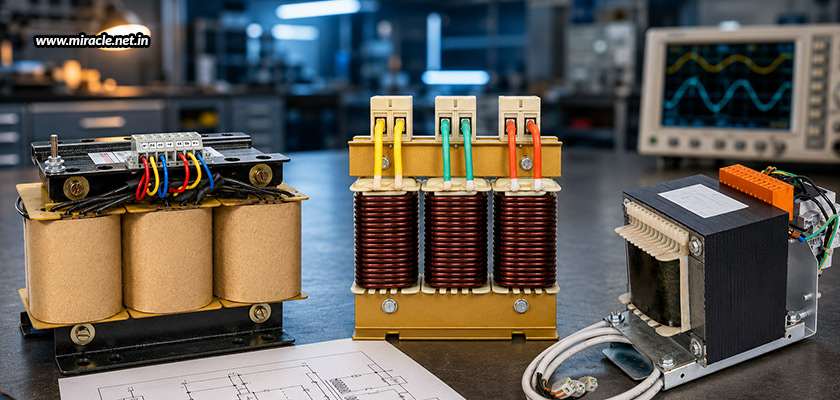
Transformers play a crucial role in many modern devices, powering a wide range of applications from switch-mode power supplies and chargers to communication systems and medical devices, as well as power transmission and industrial distribution systems. Their ability to operate efficiently across a wide range of frequencies, combined with a lightweight and compact design, renders them essential in modern electronics. However, like any technology, they come with their own set of challenges. Issues like overheating, noise, signal distortion, and reduced efficiency, if not addressed, can lead to a shortened lifespan of the transformer, diminished performance, or even system failure. This blog delves into the most prevalent issues associated with transformers, and provides well-structured methods for diagnosing, resolving, and preventing the problems.
Overheating
- Causes
Overheating is frequently associated with core saturation, which happens when the magnetic core material is exposed to magnetic flux densities that exceed its limits. Once saturation occurs, the core loses its ability to transfer energy efficiently, resulting in excessive heat. Another common factor is high winding resistance – where using thin wires or subpar winding designs increases copper losses. Overloading the transformer or operating it at an unsuitable frequency can also hasten the rise in temperature. Lastly, inadequate ventilation traps heat and hinders its dissipation, again leading to overheating. Additional causes such as eddy current losses and hysteresis losses in the core material can also contribute to overheating in both laminated steel cores used in power transformers and ferrite cores used in high-frequency designs.
- Troubleshooting tips
Begin by measuring the operating current and confirming whether the transformer operates within its rated specifications. If core saturation is a concern, evaluate the applied voltage and frequency; it may be necessary to adjust the design to accommodate a larger core size or a superior magnetic material grade. For winding-related problems, substituting wires with thicker conductors or Litz wire can reduce copper losses. If poor cooling is the culprit, enhancing airflow or positioning the transformer away from heat-producing components can help restore equilibrium.
- Preventing overheating
The most effective method to prevent overheating is through sound thermal design. Designing with a buffer below the rated limits can help with load fluctuations. Adding heat sinks, thermal vias, or implementing forced cooling can prolong operational life. Conducting regular inspections to remove dust or debris from cooling pathways further guarantees safe and stable operation.
Noise
- Causes
Audible noise frequently arises from magnetostriction, which is the natural expansion and contraction of the transformer core material when subjected to alternating magnetic fields. Insufficient winding tension or loose windings can exacerbate this phenomenon, leading to vibrations and humming. Moreover, mechanical resonance between the transformer and the PCB or enclosure can contribute to buzzing noises.
- Troubleshooting tips
Start by determining if the noise is mechanical or electrical in nature. Mechanical buzzing typically stops when you apply light pressure on the transformer casing, suggesting loose windings or inadequate mounting. To mitigate vibrations, consider tightening the windings, impregnating the transformer with varnish, or enhancing the mounting. If magnetostriction is identified as the source, switching to a lower-noise magnetic material grade may prove beneficial.
- Preventing noise
To prevent noise, it is advisable to utilize high-quality core materials with reduced magnetostriction characteristics and to maintain tight, consistent winding tension during the manufacturing process. Encapsulation or potting can also help absorb vibrations. Lastly, ensuring that the transformer is mechanically isolated from components of the PCB that are sensitive to vibrations can aid in preventing sound transmission.
Electrical failures
- Causes
Electrical failures often stem from the gradual degradation of insulation due to factors such as thermal stress, humidity, or mechanical wear. Shorts can also arise from sharp edges in windings that penetrate insulation or from contaminants like conductive dust. Voltage surges that exceed rated limits can damage insulation layers.
- Troubleshooting tips
Electrical faults typically manifest as an abrupt decline in performance. To verify, conduct insulation resistance tests or dielectric strength assessments. A visual inspection may uncover burn marks or melted insulation. In cases of insulation failure, rewinding the transformer is frequently the only viable solution, although in less critical situations, re-insulating certain areas may be adequate.
- Preventing electrical failures
Using high-quality insulation materials, implementing careful winding techniques, and applying protective varnish coatings can significantly lower the chances of shorts. Surge protection devices are essential for defending against voltage spikes. Additionally, environmental safeguards such as potting or encapsulation protect the transformer from dust and moisture, thereby prolonging the lifespan of the insulation.
Mechanical failures
- Causes
Improper handling during assembly, over-tightening of clamps, or physical impacts can lead to cracks in the cores. Additionally, prolonged overheating can gradually weaken the magnetic structure of the core material, increasing its vulnerability to breakage.
- Troubleshooting tips
Cracks may manifest as decreased efficiency, unusual noise, or unexpected drops in performance. If mechanical failure is suspected, physically inspect the core under magnification. Typically, replacing the cracked core is necessary, as repairs are often not feasible.
- Preventing mechanical failures
It is essential to handle transformers carefully during both manufacturing and assembly processes. Avoid excessive tightening and utilize cushioning materials when clamping. Effective thermal management is crucial to prevent stress fractures that can result from extended overheating.
Signal distortion
- Causes
Distortion arises when a transformer fails to preserve the shape of the transmitted waveform. Common factors include core non-linearity at elevated flux densities, leakage inductance resulting from inadequate winding geometry, and parasitic capacitances between turns. Operating beyond the ideal frequency range can also compromise waveform integrity in transformers used for signal, audio, RF, switching, and power applications, while in low-frequency power transformers distortion is generally minimal under normal operating conditions.
- Troubleshooting tips
Verify if the transformer is functioning within its specified frequency range. If distortion is detected, consider redesigning the winding configuration to reduce leakage inductance – interleaved windings are especially effective. In situations where parasitic capacitance is predominant, adding shielding layers or adjusting the spacing of windings may prove beneficial. If non-linearity is verified, it is recommended to switch to a better-suited magnetic core material that offers improved frequency response.
- Preventing signal distortion
The integrity of the signal is significantly influenced by sound design practices. Appropriate core selection, refined winding techniques, and strict compliance with rated frequency ranges are essential. Simulation tools can help forecast distortion risks early in the design phase, thereby ensuring long-term waveform fidelity.
Efficiency loss
- Causes
Transformers are valued for their efficiency; however, various factors can compromise this. Core losses increase when transformers operate at inappropriate flux densities or frequencies, whether in silicon steel cores (low-frequency transformers) or ferrite cores (high-frequency transformers). Copper losses due to resistance and skin effect also rise at elevated frequencies. Furthermore, inadequate soldering, aging insulation, or partial short circuits can gradually diminish efficiency.
- Troubleshooting tips
Start by distinguishing between core losses and copper losses. Measure the winding resistance at the operating frequency to identify high AC resistance resulting from skin effect. For inefficiencies related to the core, evaluate the material grade and verify its compatibility with the frequency. Examine solder joints and insulation for any visible deterioration, as even minor defects can lead to cumulative energy loss.
- Preventing efficiency loss
Efficiency is best preserved by choosing materials optimized for the operating range, utilizing Litz wire for high frequencies, and implementing rigorous quality control during assembly. Regular testing helps to identify minor defects before they develop into significant efficiency losses.
Diagnosing issues in transformers requires a thorough understanding of both their electrical and mechanical characteristics, as their reliability directly influences the overall performance of the devices they support. Different transformer types – ranging from low-frequency power transformers to high-frequency ferrite-based designs – may exhibit the same issues but with different underlying causes. Partnering with trusted experts like Miracle Electronics, a name recognized for top transformer manufacturing in India, ensures access to high-quality designs and precision-engineered solutions that minimize operational risks. By combining thoughtful design, proper handling, and proactive maintenance, engineers and technicians can maximize efficiency, while ensuring that these components deliver reliable, long-lasting performance.