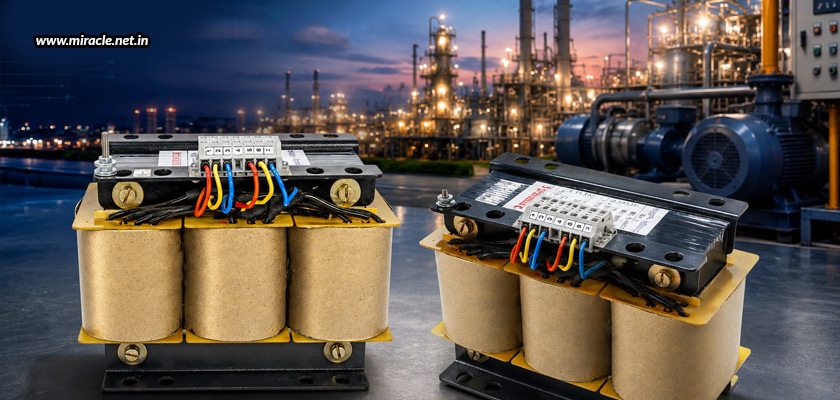
In the current energy-centric landscape, effective voltage management is crucial for ensuring stable, dependable, and economical power systems. A key element that facilitates this efficiency is the 10 KVA step-up transformer, which is extensively utilized in industrial environments. Unlike conventional transformers, a step-up transformer is specifically engineered to elevate voltage from a lower input to a higher output. This characteristic makes it an essential device in scenarios where energy must be transmitted efficiently or where equipment necessitates higher voltage. Companies like Miracle Electronics have significantly contributed to the evolution of transformer technology, guaranteeing that the 10 KVA step-up transformer is not only efficient, but also robust, compact, and appropriate for rigorous applications.
What is the 10 KVA step-up transformer?
10 KVA step-up transformers are an electrical apparatus intended to elevate voltage while preserving a power capacity of around 10 kilovolt-amperes. It operates based on the principle of electromagnetic induction, facilitating the transfer of electrical energy between the primary and secondary windings via a common magnetic field. Its fundamental role is simple: it takes in lower voltage and outputs higher voltage. By boosting voltage, it decreases current flow for the same power level, thereby enhancing efficiency and reducing energy losses during transmission or operation. With a 10 KVA capacity, it is ideally suited for small to medium industrial applications that demand a stable and increased voltage supply. This transformer is frequently utilized in equipment testing, machinery operations, and systems where reliable voltage transformation is crucial for optimal performance and energy efficiency.
Engineering inside a 10 KVA step-up transformer
The effectiveness of a transformer is significantly influenced by its internal architecture and the quality of its engineering. Premium 10 KVA step-up transformers generally feature:
- A high-quality core material that minimizes hysteresis and eddy current losses, enhances magnetic performance, boosts energy efficiency, and guarantees stable operation across varying electrical load conditions in industrial settings
- Precision winding configuration that facilitates accurate voltage transformation, reduces energy leakage, enhances coupling between windings, and ensures consistent output with diminished electrical losses and improved operational reliability
- An advanced insulation system that safeguards the transformer components from excessive heat, prevents electrical failures, increases safety, and guarantees long-lasting durability under high-voltage and continuous industrial operating conditions
- Effective cooling mechanisms that manage temperature increases, avert overheating, sustain stable performance, and prolong the lifespan of the transformer during continuous or heavy-duty electrical load operations
- Space-efficient construction that enables straightforward installation in limited spaces while ensuring high performance, durability, and efficiency appropriate for contemporary industrial electrical infrastructure configurations
How a 10 KVA step-up transformer improves energy efficiency
One of the primary benefits of a step-up transformer is its capacity to greatly enhance overall system efficiency. By increasing the voltage, the current decreases for the same power output, which directly minimizes energy loss within the system. A lower current flow also results in reduced resistive losses in conductors, ensuring that less energy is dissipated as heat during transmission. Consequently, heat generation is kept to a minimum, which not only enhances safety but also lessens the requirement for additional cooling systems. This advancement makes long-distance power transmission significantly more efficient and economical. In industrial settings, even minor reductions in energy loss can translate into substantial savings over time. For example, a 10 KVA step-up transformer enables manufacturing facilities to maintain a stable high-voltage supply to machinery while alleviating stress on wiring and enhancing the overall reliability of the electrical system.
Key industrial applications of 10 KVA step-up transformers
The versatility of 10 KVA step-up transformers makes them suitable for a wide range of industries.
- Manufacturing industries: Step-up transformers are used in manufacturing industries to power machinery requiring elevated voltage, ensuring consistent torque, precision, efficiency, and stable operation under fluctuating loads.
- Small industrial plants: Small industrial plants use step-up transformers to maintain efficient power distribution, optimize energy usage, reduce losses, and ensure reliable voltage supply for continuous operations.
- Testing and calibration labs: Precision testing and calibration equipment relies on stable, elevated voltage levels to ensure accurate measurements, repeatability, and dependable results in controlled laboratory environments.
- Automation systems: Industrial automation systems depend on stable high voltage for sensors, controllers, PLCs, and robotic equipment, ensuring accuracy, reliability, and uninterrupted synchronized operational performance.
- Export-oriented equipment: Export machinery often requires voltage adaptation to match international standards, making step-up transformers essential for compatibility, safe operation, and consistent performance across regions.
Common mistakes in selecting a 10 KVA step-up transformer
Despite its importance, many users make selection errors that affect performance.
- Ignoring load characteristics: Different electrical loads behave differently, so inductive and resistive loads must be properly evaluated to ensure correct transformer performance, stability, and long-term operational efficiency.
- Undersizing the transformer: Choosing a transformer with insufficient capacity leads to overheating, excessive stress on components, reduced efficiency, frequent failures, and ultimately a shorter operational lifespan.
- Overlooking voltage fluctuations: Failing to consider input voltage variations can negatively affect output stability, reduce equipment performance, and increase the risk of electrical stress or system malfunction.
- Poor installation practices: Improper grounding, inadequate ventilation, or incorrect wiring can reduce efficiency, increase safety risks, and significantly shorten the transformer’s overall operational reliability and lifespan.
- Ignoring future expansion possibilities: Designing systems only for current requirements can limit scalability, forcing early replacement or upgrades when load demand increases in future industrial expansions.
The 10 KVA step-up transformer plays a crucial role in contemporary electrical systems, facilitating effective voltage conversion for a variety of industrial and commercial uses. By elevating voltage and lowering current, it greatly enhances energy efficiency, reduces transmission losses, and guarantees stable and dependable performance even in challenging operating conditions. This transformer is commonly utilized in manufacturing facilities, automation systems, testing laboratories, and renewable energy installations like solar power systems. As industries place greater emphasis on energy efficiency and sustainability, the need for compact and efficient transformers is on the rise. Today’s 10 KVA step-up transformers are engineered with cutting-edge materials, enhanced insulation, and superior thermal management, rendering them more reliable, durable, and prepared for future demands than ever before.