Inductors are essential components in modern electrical and electronic systems, where they continuously operate under varying electrical and thermal stresses, yet helping with energy storage, filtering, and power conversion. Another challenge that inductors face during operation are the core losses, which are crucial in determining an inductor’s efficiency, reliability, and lifespan. Core losses are the energy dissipated as heat within the core material of the inductor when an alternating magnetic field is applied. If not managed, these losses can lead to excessive temperature rise and reduced efficiency, or even premature component failure! Let’s understand more about core losses in the blog below.
What are core losses?
Core losses are the losses that occur in the core of an inductor when an alternating magnetic field is applied. These losses are primarily associated with AC operations, and are negligible in DC applications. In practical circuits, inductors experience rapidly changing magnetic flux, making core losses unavoidable and significant. The core losses can be mainly of two types – Hysteresis losses and Eddy current losses. Hysteresis loss occurs due to the repeated magnetization and demagnetization of the core material, while eddy current loss arises from circulating currents induced within the conductive core. Understanding these two loss mechanisms is very crucial, as this knowledge helps engineers select appropriate core materials, optimize core geometry, and implement design strategies to reduce energy wastage, ultimately improving system-level efficiency and reliability.
What is Hysteresis loss?
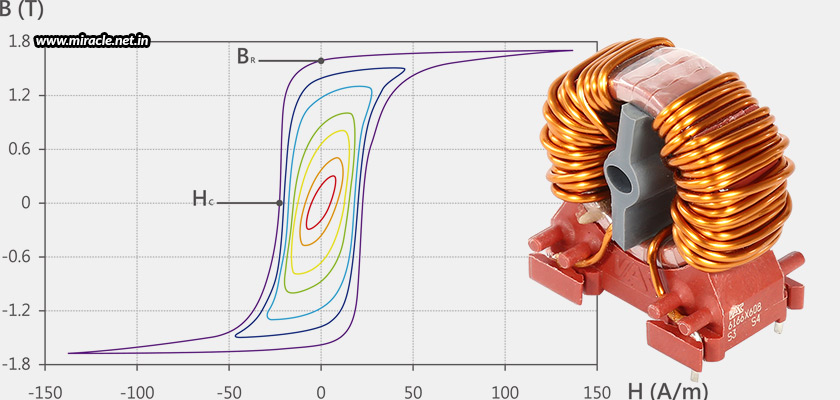
Hysteresis loss occurs when there is repeated magnetization and demagnetization of the core material as the magnetic field alternates. Every time the magnetic domains realign to follow the applied magnetic field, a small amount of energy is dissipated as heat, which is the Hysteresis loss. This loss is directly related to the magnetic properties of the core material. It depends on the peak magnetic flux density and increases linearly with frequency; however, it can also occur at low frequencies. Hence, the main factors that influence Hysteresis losses are the core material, the magnetic flux density, the operating frequency, and the material microstructure and composition. This is why soft magnetic materials with narrow hysteresis loops are preferred as they are able to minimize Hysteresis losses.
What is Eddy current loss?
Eddy current losses arise when a changing magnetic field induces circulating electrical currents within the core material. These current flow in closed loops inside the core, and dissipate energy as heat due to the material’s electrical resistance. Eddy current losses increase the core temperature and reduce overall efficiency, without contributing to useful magnetic energy storage. These losses increase with the core material’s conductivity, the core thickness, magnetic flux density, and frequency. If the material and design of the core are not carefully chosen, Eddy current losses can become the dominant component of total core loss at high frequencies, making proper material selection and lamination design critical for high-performance inductors.
Combined impact of core losses on inductor performance
Energy lost is dissipated as heat, which leads to uncreased operating temperatures, which can degrade the insulation materials and accelerate aging and failure. The heat also reduces magnetic permeability and reduces the amount of power delivered to the load. Even small efficiency losses can thus significantly impact the overall system performance.
As the temperature rises, the core material properties also change, resulting in reduced inductance, increased ripple current, and altered saturation characteristics. These temperature-induced variations can stress surrounding components, cause control loop instability, and lead to unpredictable circuit behaviour. Designers must consider thermal effects when selecting core materials, winding configurations, and operating conditions to maintain consistent inductor performance across the expected temperature range.
Persistent high temperatures also accelerate material degradation, leading to cracking, insulation breakdown, and eventual inductor failure, particularly in high-reliability or continuous-duty applications. Repeated thermal cycling can worsen these effects, increasing the likelihood of catastrophic failure. Implementing proper thermal management, such as heat sinks, airflow, and thermal interface materials, is crucial to prolong inductor life and maintain stable system operation.
Core material selection for reducing losses
Choosing the right core material is one of the most effective ways to reduce core losses. The most common and effective core materials include ferrites, silicon steel, powdered iron, and nanocrystalline and amorphous alloys.
- Ferrites: Ferrites have low electrical conductivity, and result in very low eddy current losses, making them ideal for high-frequency applications.
- Silicon steel: Silicon steel has high saturation flux density, and results in higher losses at high frequencies, which makes it ideal for mainly in low-frequency power applications.
- Powdered iron: Powdered iron cores have a distributed air gap and exhibit moderate losses, making them well-suited for energy storage inductors.
- Nanocrystalline and amorphous alloys: Nanocrystalline and amorphous alloys offer extremely low hysteresis loss and high permeability, making them ideal for high-efficiency and high-power designs.
For engineers seeking high-quality solutions, Miracle Electronics, a leading inductor manufacturer in India, offers a wide range of inductors optimized for minimal core losses, high efficiency, and reliable performance, catering to applications across power electronics, energy storage, and high-frequency circuits.
Design optimization techniques for reducing losses
Reducing inductor losses is crucial for enhancing efficiency, reliability, and lifespan. By carefully optimizing core material, geometry, flux levels, and thermal management, designers can minimize hysteresis and eddy current losses while ensuring stable, high-performance operation.
- Core material selection
Matching the core material to the operating frequency range is another essential strategy. For high-frequency switching applications, ferrite cores are ideal due to their low losses at elevated frequencies. Conversely, materials with high conductivity should be avoided at higher frequencies, as they can lead to excessive eddy current losses and reduced efficiency.
- Core geometry optimization
The core shape considerably influences the magnetic path length and flux distribution. For instance, toroidal cores minimize leakage flux, E- and U- shaped cores allow controlled air gaps, and thinner laminations reduce eddy currents. Optimized geometry ensures uniform flux distribution and lower localized losses.
- Avoiding core saturation
Designing an inductor to operate below the core’s saturation flux density significantly reduces both hysteresis and eddy current losses. This can be accomplished by increasing the core size, introducing strategically placed air gaps, and carefully balancing the magnetic path, ensuring the inductor operates efficiently under all load conditions.
- Improved thermal management
Effective heat dissipation is essential to maintain stable operation and enhance reliability, which can be achieved through proper PCB layout, ensuring adequate airflow, using thermal interface materials, and incorporating heat sinks for high-power inductors. By keeping the operating temperature low, material losses are minimized, which directly improves efficiency and extends the lifespan of the inductor.
Core losses are a fundamental consideration in inductor design, directly influencing efficiency, thermal behaviour, and long-term reliability. By understanding the hysteresis and eddy current losses, and making informed decisions about material selection, core geometry, and thermal management, engineered can balance flux density, frequency, and thermal constraints, which in turn can significantly reduce core losses and achieve high-performance inductors suited for today’s demanding power and electronic systems. As applications continue to push toward higher frequencies, higher power densities, and greater efficiency, core loss optimization will remain a critical pillar of inductor engineering now and forever!