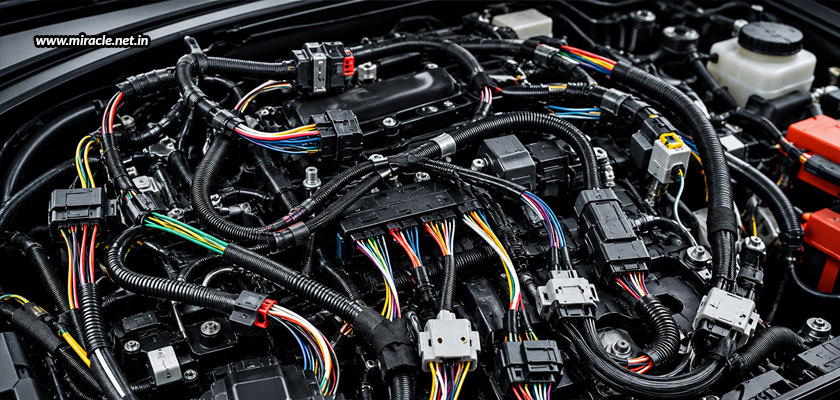
Airbags, anti-lock braking systems, and crash detection technologies are no longer optional in modern vehicles; they have now become fundamental to vehicle design and regulatory compliance. And, with all of these critical systems working in tandem, one key element ensures they operate together safely, reliably, and without disruption – the wire harness system. Wire harnesses act as the physical medium through which power and data travel across these systems. One single error in the harness – may it be due to material fatigue, or environmental exposure, or signal interference – can compromise the entire safety chain. Let’s explore the engineering-critical role of wire harnesses in vehicle safety systems, with a focus on reliability, durability, and failure prevention.
Wire harnesses in vehicle safety
Vehicle safety systems operate as interconnected networks, rather than as individual components. For instance, the crash sensors feed data to the control units, the control units then issue commands, and the actuators respond instantly. Wire harnesses enable this continuous loop by providing stable power delivery to safety modules, accurate transmission of sensor signals, and real-time communication between distributed control units. But, the safety harnesses are required to operate with near-zero tolerance for signal loss, delay, or distortion. Their performance directly affects reaction time, diagnostic accuracy, and system reliability under both normal and extreme driving conditions.
Harnesses in critical safety systems
- Harnesses in airbag systems
Airbag systems are one of the most critical applications within a vehicle. During a collision, impact data is required to travel from crash sensors to the airbag control unit, and back to deployment mechanisms within just fractions of a second. Any electrical inconsistency here can disrupt this sequence. Airbag harnesses are engineered with redundant circuits, secure locking connectors, and EMI-resistant wiring layouts to avoid single-point failures, prevent accident disconnection, and maintain signal clarity. The wire harnesses also remain functional during structural deformation, ensuring electrical continuity long enough for the system to execute deployment decisions.
- Harnesses in ABS systems
Anti-lock braking systems depend on continuous high-frequency data streams from wheel speed sensors, steering angle sensors, and inertial measurement units. The accuracy of this data directly influences braking force modulation and vehicle stability corrections. The wire harnesses supporting these systems maintain consistent electrical resistance, operate reliably in high-moisture zones, and resist vibration-induced conductor fatigue. Because anti-lock braking systems are often routed close to wheels and underbody components, they face constant exposure to water spray, road salts, debris impact, and thermal cycling. This makes protective sheathing, sealed connectors, and abrasion-resistant insulation absolutely essential.
- Harnesses in crash detection systems
Crash detection systems rely on distributed sensor networks positioned across the vehicle structure, with the sensors connected through dedicated safety harnesses that are required to transmit impact data instantly. Harness routing in these systems is strategically planned around crumple zones, controlled deformation paths, and structural reinforcements. The goal is not just protection during normal operation, but controlled survivability during a crash event, allowing the safety system to complete its decision-making process before electrical continuity is lost. To achieve this, harnesses are engineered with specific slack, shielding, and mounting points that accommodate sudden movement and deformation. This ensures that critical signals remain intact during the milliseconds when crash data is most vital for activating occupant protection systems.
Design challenges in safety harnesses
- EMI challenges in safety harnesses
As vehicles integrate more and more electronic systems, EMI has become a significant challenge. Safety systems are particularly sensitive to EMI, as corrupted signals can result in delayed or incorrect responses. To address this, safety harnesses are required to incorporate shielded cables, twisted-pair configurations, and optimized grounding strategies. Effective EMI management ensures that safety signals remain accurate even in electrically dense vehicle architectures. In addition, harness routing is carefully planned to avoid proximity to high-current power lines, inverters, and switching components that generate electromagnetic noise. Material selection, connector design, and proper termination further support signal integrity. Together, these measures help maintain reliable communication between sensors and control units, reinforcing overall vehicle safety performance.
- Environmental stress on safety harnesses
Vehicle safety harnesses must function reliably across the full operational life of a vehicle. During this time, the harnesses are exposed to extreme temperature variations, continuous vibration and movement, humidity, corrosion, and chemical exposure. The right materials with high-quality insulation, robust protective coverings, and corrosion-resistant terminals can help prevent degradation that could otherwise lead to intermittent faults or system shutdowns. In addition, harness designs must account for long-term mechanical stress caused by vehicle motion and component wear. Secure fastening methods, abrasion-resistant sleeving, and strain relief features further enhance durability. These measures ensure consistent electrical performance over years of operation, even in demanding driving conditions and harsh environmental environments.
Why harness quality matters
Failures like insulation wear, conductor fatigue, and connector corrosion develop gradually over time, making it difficult to detect them until system diagnostics flag an error or until performance is compromised during a critical event. In safety-critical applications, even a brief signal interruption can prevent timely system response, increasing the risk of malfunction. Poor harness quality can also lead to recurring faults, higher maintenance costs, and reduced vehicle reliability. By contrast, high-quality harnesses are engineered to maintain electrical integrity under mechanical stress and harsh environments, ensuring consistent performance and dependable operation throughout the vehicle’s service life.
The role of Indian wiring harness manufacturers in vehicle safety
A reputed automotive wire harness manufacturer in India like Miracle Electronics can deliver automotive wiring solutions, emphasizing precision manufacturing and compliance-driven quality assurance to support safety-critical vehicle applications. Such manufacturers operate within strict automotive standards, ensuring every harness meets performance, durability, and reliability requirements. Advanced testing processes, including continuity checks, insulation resistance testing, and vibration validation, help eliminate potential failure points before deployment. In addition, close collaboration with vehicle manufacturers allows harness designs to be customized for specific platforms and operating conditions. This combination of engineering expertise, quality control, and scalable production enables consistent delivery of dependable wiring systems for modern, electronics-intensive vehicles.
Modern vehicles depend on complex electronic systems that must perform flawlessly under demanding conditions, making wiring harness quality a critical factor in overall safety and reliability. From crash detection and EMI control to long-term durability, every design and manufacturing decision directly influences system performance during both everyday operation and critical events. High-quality automotive wiring harnesses ensure uninterrupted signal transmission, structural survivability, and compliance with stringent safety standards. As vehicles continue to evolve with increased electronic integration, partnering with experienced and quality-focused harness manufacturers becomes essential. Reliable wiring solutions not only support advanced safety technologies but also contribute to long-term vehicle performance, reduced failure risks, and enhanced occupant protection.